Showing posts with label Kulinarya Cooking Club. Show all posts

Sunday, 21 October 2012

FILIPINO STYLE SPAGHETTI


Spaghetti, though an everyday food, brings fond memories of special occasions. Every birthday party probably has spaghetti as one of the dishes served. For me, spaghetti brings to mind Christmas. We always serve spaghetti for Christmas brunch. All the children (as well as the adults) look forward to spaghetti. If we are lucky enough to have leftovers, we look forward to eating pan fried spaghetti for breakfast the next day. The pasta with sauce is heated in a pan with a touch of oil. The spaghetti becomes dry and caramelized with toasty bits of meat and cheese. Super delicious!

Monday, 30 July 2012

STIR FRIED GREEN BEANS ADOBO


Bitter memories came flooding back when I read the e-mail from this month's Kulinarya Cooking Club hosts Isabel of My Expat Mommy and Kai of Bucaio. The theme for July and is the most unlikely source of such thoughts, yet it required me to dig deep into my memory bank and once again remember the sort of food that I dread.

Thursday, 21 June 2012

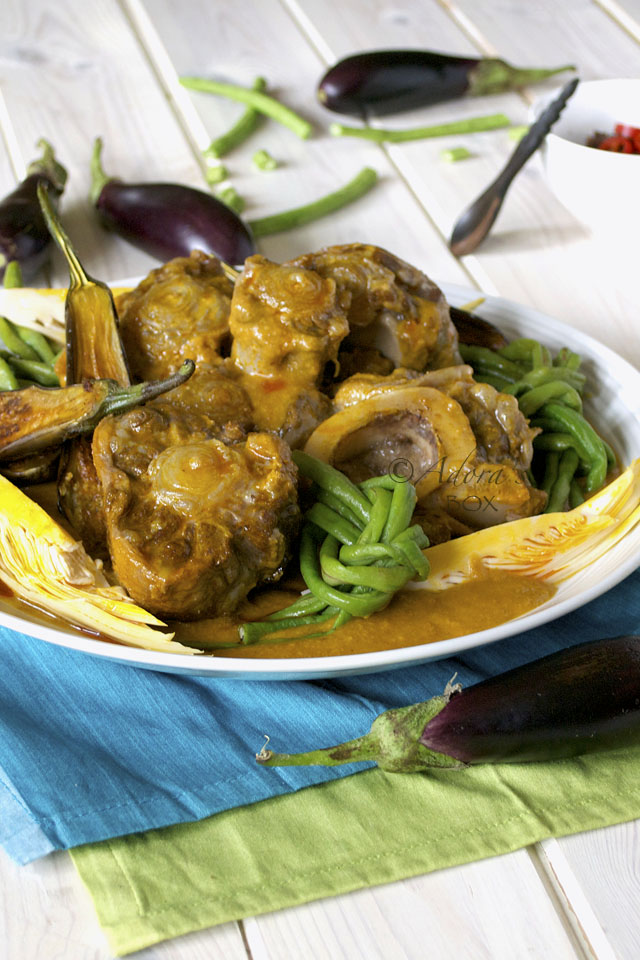
KARI KARI (FILIPINO OXTAIL STEW)


As a Filipino, I naturally love Filipino food. It is the food my tastebuds have been honed on. Although it is one of the lesser known Asian cuisine, those who have tasted it, rave about it. Not much herbs and spices are used but the flavour comes from the natural taste of the best ingredients. A lot of our food are simple and probably doesn't have an edge in terms of presentation. I think for our food to have a wider multicultural fan base, we have to present them in a way which is more universally appealing.

Our Kulinarya Cooking Club theme for this month of June, courtesy of our gracious hosts Tina of Pinay in Texas Cooking Corner and Cherrie of  Sweet Cherrie Pie is native Filipino cuisine. A recent revival of Filipino heritage dishes has brought to the fore old recipes that through the years have been eclipsed by modern and foreign cuisine. Although a lot of Filipino dishes has Spanish or Chinese influence, there are also a lot of indigenous Filipino dishes that truly originated from the Philippines. 


Kari kari, also called kare kare, is one of the all time favourite native dishes. It is a stew, usually made with oxtail or tripe or a variety of meat cuts (I used oxtail and shin of beef with marrow bone), with a rich peanut gravy that derives its characteristic yellow color from annatto seeds. Ground fried or roasted peanuts and ground toasted rice grains provide richness to the sauce. Although modern cooks use peanut butter, ground peanuts is the traditional and correct ingredient for making the traditional recipe. Kari kari is not complete if not served with a side dish of ginisang bagoong (sauteed shrimp paste). 

Kari kari apparently originates from the Southern part of the Philippines. It was brought to Manila by the Moros (the Southern natives) where it was embraced as a national dish. The flavour is very characteristically Malay, owing to the Southern tip of the Philippines' proximity to the other Southeast Asian countries. Although there has been mention of the name being derived from the word curry, I think the more logical explanation is that the Malay term for dishes with sauce is kari which simply means sauce.


I have interpreted this dish in a way that can be better appreciated by Filipinos and non-Filipinos alike. It is one of those Filipino stews that becomes uniform in colour when cooked. Filipinos say that our food is unappealing because it is usually brown. In this case, it is yellow. I have cooked the vegetables separately and just added them to the dish in the end. This way, the sauce remains pure and rich, undiluted by the juices of the vegetables. The vegetables have retained their original colour too because they were not cooked in the yellow sauce. 


Ingredients:

1 1/2 kg. oxtail and shin of beef meat
3 large onions, sliced
cooking oil
3 tbsps. of annato (achuete) oil
1 1/2 tbsps. crushed garlic
1/4 c. ginisang bagoong (sauteed shrimp paste)
3 tbsps. toasted store bought ground rice
2/3 c. ground fried or roasted peanuts
8 snake beans (sitaw)
6 eggplants or 10 baby eggplants
1 fresh banana heart, split into 6 wedges and soaked in salted water (or use tinned cooked banana heart like I did here)
ginisang bagoong to serve

Method:

Cut the shin meat into big chunks, similar to the size of the oxtail pieces. 

Pan fry all the meat pieces, a few pieces at a time in the cooking oil until well browned all over. 

Transfer the browned meat and 1/3 of the onion slices into a big pot and cover with water. 

Bring to a boil and simmer until tender (about 2 hours). This can also be done in a pressure cooker for 20 minutes.

Take the meat out of the stock and set aside. Strain the stock and skim off the fat from the surface.


Toasted rice and ground peanuts.
Heat up a big pan or wok and add the annato oil. Sauté the garlic on low heat until fragrant and starting to crisp. 

Add the onions and sauté until very soft. Add the peanuts and bagoong and stir for about 2 minutes. 

Add 5 cups of the stock and bring to a boil. 

Add the ground rice. Bring to a boil and simmer for 3 minutes. 

At this stage, I pureed the sauce with a hand blender because I like my sauce smooth. 

Return the meat to the sauce and simmer on low heat for 10 minutes.


Store bought ginisang bagoong.
Split the eggplants into halves, lengthwise, and fry until cooked. 

Boil the snake beans and banana heart separately.

Add the vegetables to the kari kari and simmer for 3 minutes. Serve with ginisang bagoong.


For the annato (achuete) oil:

Heat up 1/2 cup of cooking oil. When hot add 2 tbsps. of annato (achuete) seeds. Take off the heat and leave to steep and cool. Strain the seeds off. Use the oil in recipes.


All rights reserved ©Adora's Box Copyright 2011.  


                        See the other posts for this month's theme:


Palitaw  from Day of Chef by Day 
Avocado Shake from Malou of Skip To Malou
Pinais na Isda from Iska of Iskandals.com
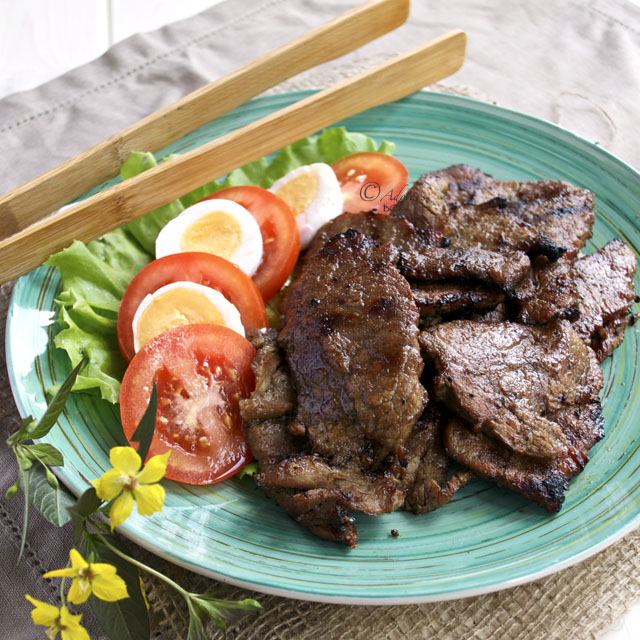
Tapsilog from Cherrie of Sweet Cherrie Pie
Kulawong Talong from Elizabeth of Asian In America
Kalamay na Pinipig from Jun of Jun-blog


Please support Adora's Box by making your Amazon.com and mymemories.com (use the code STMMMS55174) purchases from this site. Click on their respective banners to proceed to their websites. It will not cost you a single cent more but will help sustain this blog. Thank you.

You might also like
Sweet and Spicy Beef Tapa

                                          Lechon Manok (Filipino Roast Chicken)

Pork Menudo
Thanks for dropping by. It would be nice if we could meet up on FACEBOOK or TWITTER

Saturday, 28 April 2012

SISIG POCKETS


Filipino food is one of the lesser known cuisines from the Far East. It is not that it doesn't cater to popular tastes. It actually does. So people ask why, if Filipino food was actually good, are there not a lot of Filipino restaurants around? I can only surmise that it is because Filipino food takes time to cook. It is not as quick and easy to prepare as other Asian food. 

Thursday, 22 March 2012

RED BEAN SWIRL ICE LOLLIES


It is nearly the end of March and I still feel like Christmas has just gone. Time flies so so swiftly.

It is officially spring and we switch our clocks back to British summer time on the 25th of March. Thanks for that because some of our clocks are still on summer time. 

Thursday, 16 February 2012

LECHON MANOK (FILIPINO ROAST CHICKEN)


It is once again time to cook with my Filipino fellow foodies at the Kulinarya Cooking Club. Our hosts for this month, Abigail of My Nappy Tales and Marni of Kensington Kitchen chose a lovely theme for the month of February. The task is to cook a dish that reminds one of one's first love.

I seem to be too old to remember the first real love. So I just had to think long and hard but can only think of one, just the one. It just has to be my husband. I'm not saying this because he reads the blog but because it is the feeling that I remember well. 


My husband is not a Filipino but a pure Chinese from Malaysia. When he first visited the Philippines, he immediately fell in love with the cuisine. Among his favourites were crispy pata (crisp fried pork shank), bulalo (bone marrow soup), kari-kari (a stew with peanut gravy), grilled pork, clam soup, everything with ube (purple yam), mangoes, the list goes on and on. One dish, though, stands out. It is lechon manok. This is the poultry counterpart of roast pig. Lechon manok is Filipino rotisserie chicken cooked in an outdoor pit. As with all of our food, it is well seasoned and very tasty. Every time we visit home, there is a lechon manok on the dining table to welcome him.


Although cooked on a spit, lechon manok is so unlike rotisserie chicken. It has an aroma and taste that it quintessentially Filipino. I haven't yet come across a recipe that gives out the secret of the famous Andok's (a famous chain) lechon manok but this is my way of cooking it. What I'm going for is a very fragrant and extremely tasty chicken that is evocative of warm climes and rural settings. 


My method of cooking lechon manok is nothing like the usual way it is cooked. After seasoning the chicken, I wrap it in banana leaves and kitchen foil before roasting. The cavity is also stuffed with garlic, ginger and pandan leaves. This results to a highly scented, flavourful and succulent chicken. Instead of the usual liver sauce that it is usually served with I opted for a fresher, zestier sauce using his favourite fruit: mango. I hope people get to like this recipe because my husband wishes to open up a lechon manok chain in the future.


Ingredients for the roast chicken:


1 whole chicken
2 tbsps. light soy sauce
1 tsp. salt
1 tsp. garlic powder
1 tsp. turmeric
1 tbsp. lime juice
1 tbsp. cooking oil
2 garlic cloves, smashed
a few slices of ginger
3 pandan leaves, knotted
banana leaves
aluminum foil


Mix the soy sauce, salt, garlic powder, turmeric and lime juice. Rub the mixture all over the chicken, including the cavity. Stuff the cavity with the garlic, ginger slices and pandan leaves. Leave to marinade for 30 minutes. 


Preheat the oven to 400° F / 200° C. 

Lay the banana leaves on top of a big sheet of aluminum foil. Lay the chicken on top of the banana leaves, rub with the 1 tbsp. of oil and wrap with the leaves then wrap tightly with the sheet of aluminum foil. 

Lay the wrapped chicken on a baking rack in a roasting tin. Add water to the tin so that the drippings don't burn.


Bake for 30 minutes. Lower the oven temperature to 350° F/ 180° C. 

Open the chicken parcel. Cook for a further 50-60 minutes, turning at half time to brown the other side of the chicken. Brush with the drippings occasionally.


The chicken can also be cooked in a lidded barbecue instead of the oven for the last hour. Use a grilling tray so the chicken doesn't stick to the grilles.


Let rest before chopping into serving pieces.

Ingredients for the mango-lime chilli sauce:


1 1/4 c. pure mango juice
juice and grated rind of 1 lime
5 tsps. white sugar
2 tsps. corn flour
1 tbsp. water
3 cloves of garlic, chopped
1/2 red fingr chilli, chopped
1 tsp. grated fresh ginger
4 tsps. fish sauce


Put the mango and lime juice and the sugar in a saucepan and bring to a boil. Stir until the sugar melts. Disperse the corn flour in the water and add to the mixture in the saucepan to thicken. Leave to simmer for 2 minutes. Add the rest of the ingredients, stir and bring back to a boil. Take off the heat and transfer to a jug or gravy boat to stop it cooking further. Serve with the chicken.


All rights reserved ©Adora's Box Copyright 2011. 

Please support Adora's Box by making your Amazon.com and mymemories.com (use the code STMMMS55174) purchases from this site. Click on their respective banners to proceed to their websites. It will not cost you a single cent more but will help sustain this blog. Thank you.


You might also like 
                                        Salt Baked Chicken (Pinaupong Manok)
Chicken Inasal
Filipino Barbecue Chicken
Thanks for dropping by. It would be nice if we could meet up on FACEBOOK or TWITTER

Thursday, 19 January 2012

SALT BAKED CHICKEN (PINAUPONG MANOK)


The Kulinarya Cooking Club's theme for this month is a healthy version of a dish for one's birthday party. I know we tend to indulge and throw our cares away on our birthdays but with the holidays just over, it makes sense to think of delicious yet healthy dishes that we can serve for celebrations. 

Saturday, 17 December 2011

STUFFED ROAST CHICKEN (RELLENONG MANOK)


It is that time of the month again when we, at the Kulinarya Cooking Club, get to celebrate our Filipino cuisine by having a virtual potluck of our beloved dishes. This month's theme is special not just because of Christmas but because we get to present a special dish that we usually cook for Noche buena

Friday, 18 November 2011

CHICKEN ARROZ CALDO


The healing and comforting properties of chicken soup is legendary and is known and accepted worldwide. Each country has their own kind of chicken soup. It is one dish that is best when home made. The love and care that went into making it is what makes it taste so delicious.

Friday, 23 September 2011

UBE MACAPUNO INIPIT


The Kulinarya Cooking Club's theme for the month is red, white, blue and yellow. These are the colours of the Philippine flag. We are paying homage not only to our flag and country but also to our national heroes. This month's great hosts are Ray of Wok with Ray, Oggi of I Can Do That, Chef Theodore Salonga of Chef by Day and Boyet of Reel and Grill.

Friday, 17 June 2011

WHITE CHOCOLATE AND MANGO MINI SANS RIVAL


Sans Rival is a classic Filipino dessert which simply means without rival. It is unrivaled in decadence because of the amount of butter, eggs and nuts it contains. Several layers of meringue with chopped cashews are frosted and filled with cream mousseline (eggyolks, sugar syrup and butter). More chopped nuts pepper the whole cake. It is truly delicious but too rich and too sweet.


Diona of Tita Flips and I are the hosts this month at the Kulinarya Cooking Club. We have chosen a white theme for the wedding month of June. I have chosen to simplify and deconstruct the elaborate sans rival (nearly destroy also). I have made meringue wafers instead of sheets, filled with mango curd and drizzled with white chocolate ganache. They are not as impressive in looks as a big gateau but what they lack in looks is made up for by the taste.


Ingredients for the meringue wafer:


1 cup of egg whites
1 cup sugar
1 cup of chopped cashews
1/2 tsp. vanilla


Method:


Draw 3" circles on a sheet of paper to make a template for your meringue wafers. 

Cut sheets of non-stick baking parchment to line your baking sheets with. Put the template in between the baking sheet and baking parchment. You will need about 4 sheets of baking parchment. 


Prepare your meringue. Whisk the egg with an electric mixer until frothy. Gradually add the sugar and whisk until stiff. Fold in the chopped nuts and vanilla extract. Transfer to a piping 
bag with a plain nozzle.


Using the template as a guide, pipe circles on the baking parchment, starting from the edge then going towards the center. Keep the nozzle close to the paper to make thin discs. Pull out the template before putting the pan in the oven and use the template for the rest of the baking parchment sheets. 

Bake at 230° F/ 110° C for 30 minutes or until crisp and dry. Let the meringue cool down before carefully peeling off the paper.


Transfer to a cooling rack. Prepare the filling.


Ingredients for the mango curd:


1 1/2 c. mango purée
1/3 c. sugar
7 egg yolks
1 tbsp. corn flour (corn starch)
1 tbsp. water
2 tbsps. butter


I used tinned sweet Alphonso mango purée for this that's why it's darker in colour. You can puree fresh mangoes. 

Put the mango purée, sugar and egg yolks in a sauce pan and blend together. Cook on low heat until it boils. Mix the corn flour and flour together and add to the mango mixture while stirring. Continue cooking until thick. 

Transfer to another bowl and set a circle of parchment paper on the surface to prevent skin from forming. Leave to cool, then refrigerate.


For the white chocolate ganache:


100 mls. double cream
200 gms. white chocolate


Chop the white chocolate roughly and transfer to a mixing bowl. Put the cream in  a microwaveable container and heat for 45 seconds. Pour over the chocolate and whisk until it melts and the mixture becomes smooth. Leave to cool.


To assemble:


You'll need 5 wafers per mini cake. Spread a little bit of mango curd in between the wafers. I put a bit too much. It tastes nice but made the wafers soft. 

Drizzle with the ganache. Decorate as you like. I used slivers of dried mango and chopped cashews. Refrigerate, then serve chilled.


This post is  for the KULINARYA COOKING CLUB theme for June 2011: White.

See the posts of the other members by visiting their blogs.


All rights reserved ©Adora's Box Copyright 2011. 

Please support Adora's Box by making your Amazon.com and mymemories.com (use the code STMMMS55174) purchases from this site. Click on their respective banners to proceed to their websites. It will not cost you a single cent more but will help sustain this blog. Thank you.

You might also like 
                                                Peach and Mango Trifle
Peach and Mango Biscotten Torte
Brazo de Mercedes
Thanks for dropping by. It would be nice if we could meet up on FACEBOOK or TWITTER

Friday, 20 May 2011

BUCO (YOUNG COCONUT) MERINGUE PIE


The summer season in the Philippines culminates in the month of May. A lot of towns celebrate their town fiestas, most of which feature a religious pageant called the Flores de Mayo, which literally translates to flowers of May. The prettiest young ladies dressed up in formal evening finery join a procession around the town.

Saturday, 16 April 2011

LECHE FLAN CHEESE CAKE


Leche flan (creme caramel) always evoke memories of town fiestas. Although the ingredients are just eggs, milk and sugar, it is always part of the array of special fiesta fare. I don't really know if you can make just one leche flan as the recipe always makes at least two. 

Thinking about it brings a flashback of kitchen memories: stacks of flaneras (flan molds) being lined with caramel syrup in readiness for the egg custard, steamers billowing steam clouds ready to be loaded with the uncooked flans, and the best pressed glass platters being prepared to serve the flans. As a child, I always wanted to be in the hub of the preparations. I loved watching people cook. I loved being handed little morsels to taste. What I loved most was to sneak out a prepared flanera, crack the caramel at the bottom and eat the shards. What joy!


I have never lost my taste for leche flan but never get to eat a lot of it. It is because I want to reserve it for special occasions. The Kulinarya Cooking Club's theme for April is a memorable and decadent Filipino food. The theme in itself is one mouthful. So I decided to bring to the table a concoction that embodies everything I like.

I injected a touch of decadence to the classic leche flan by adding cream cheese to the flan mixture and using a sponge cake as a base. It is cross between a cheesecake and a custard cake. It has all the goodness and creaminess of an all egg yolk leche flan, mixed with cream cheese instead of just pure milk and flavoured with lime zest and vanilla. The base is soft and light vanilla sponge cake instead of biscuit crumb. The two together has an uninterrupted creamy and voluptuous texture. Caramel syrup contrasts with the cheese cake and crowns the dessert. It gives a toasty accent  to this creamy concoction. 

Note: I have made this cake several times with success and this is the recipe I've used. However, I do apologize, that because of a typographical error, the recipe fails. This has now been corrected, additional instructions supplied and the amount of caramel reduced ( to temper the sweetness).

The sponge is not as moist as regular sponge. I have tried other cake bases but this is the lightest one so far and is the only one that floats on the cheesecake base. I have seen similar cakes (called flancocho) that uses yellow cake mix as one of the ingredient for the base but I didn't use that because it comes with a warning that the cake mixture may sink into the cheesecake mixture.

This is the recipe for the above cheesecake shown in the picture and I hope you give it a try.


Ingredients for the cream cheese leche flan:


3/4 c. sugar
3 tbsps. water
1 can of sweetened condensed milk
8 oz. cream cheese (about a cup)
6 egg yolks 
1 tsp. vanilla
grated zest of 1 lime


Method:
Pre-heat the oven to 325°F /170° C. Prepare a 9" diameter cake pan. 

Put the sugar and water in a saucepan. On low heat, melt the sugar while stirring. When the sugar melts, stop stirring, and bring the mixture to a boil. Cook on medium heat until the syrup is a deep golden brown. Do not overcook.

Brush the sides of the pan downwards with a wet pastry brush to prevent sugar crystals from forming. 

When ready, pour into a greased 9" diameter cake tin and swirl to coat the bottom. Set aside. 

Whisk the rest of the ingredients together until smooth. Set aside. 

Prepare the cake batter.


Ingredients for the sponge cake:


3 whole eggs, room temperature
1/3 c. sugar
1/2 tsp. vanilla
1/2 c. flour


Whisk the eggs and sugar until thick and light coloured. The mixture should leave a trail when drizzled on its surface. Sift the flour over it and fold with a metal spoon.


TO ASSEMBLE:


Pour the cream cheese flan mixture into the caramel syrup coated pan. This step is important so that the cake batter doesn't sink: pour the cake batter on the back of a big spoon into the flan mixture. The batter will float on top of the flan mixture. Do not stir. 

Bake au baine marie: Fill a baking tray that's big enough to accommodate the cake pan and fill with water to reach up to a quarter of its side. Make sure that your cake pan is tight. Wrap the bottom and sides with foil to be sure. Bake for 50 minutes to an hour. Test with a cocktail stick. The cocktail stick should feel sticky when the flan at the bottom is cooked.

Leave to cool in the pan. Refrigerate. Run a sharp knife around the sides of the cake pan before inverting into a serving dish to serve. If you find it difficult to unmold. Sit the bottom of the cake pan in pan of hot water.


All rights reserved ©Adora's Box Copyright 2011. 

Please support Adora's Box by making your Amazon.com and mymemories.com (use the code STMMMS55174) purchases from this site. Click on their respective banners to proceed to their websites. It will not cost you a single cent more but will help sustain this blog.


This post is  for the KULINARYA COOKING CLUB theme for April 2011:    Decadent Filipino Food. 


See the posts of the other members by visiting their blogs.


You might also like
Condensed Milk Leche Flan

Easy Lime Cheesecake
Thanks for dropping by. It would be nice if we could meet up on FACEBOOK or TWITTER